
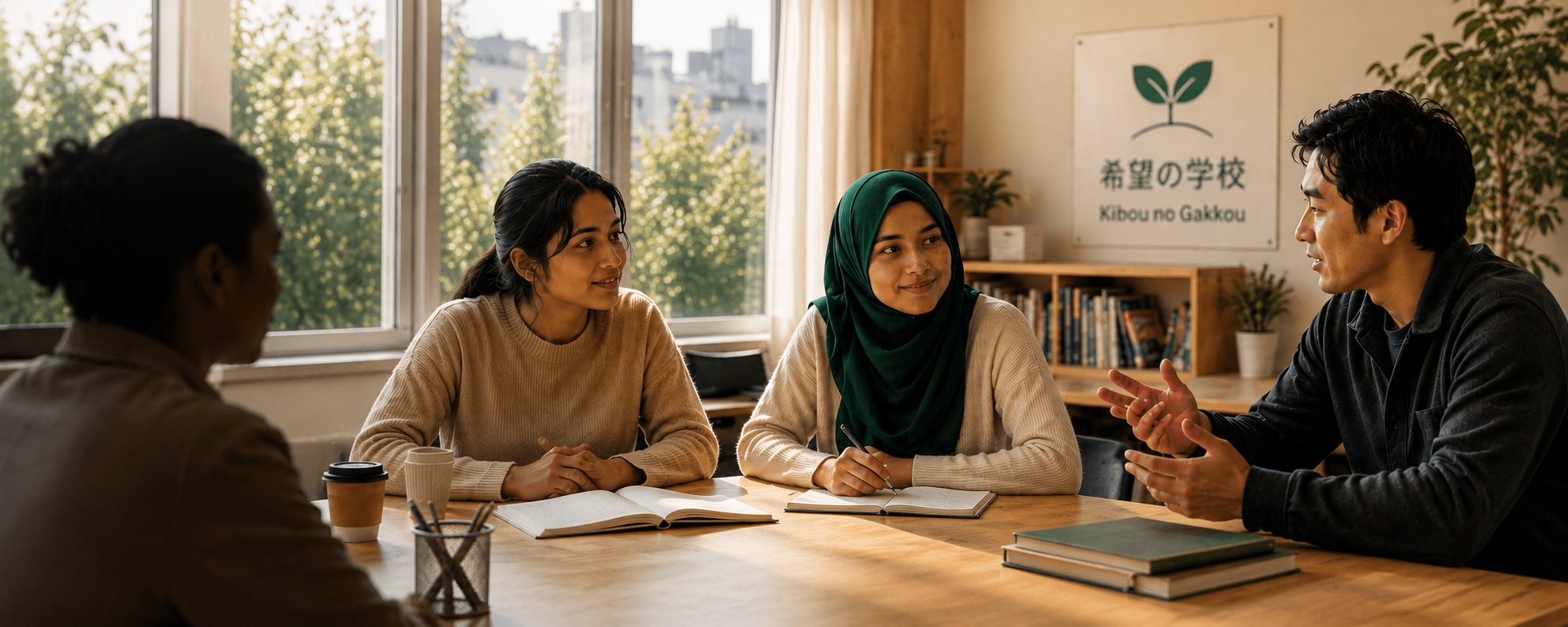
A Japanese society where refugees are able to rebuild their lives with dignity, independence, and meaningful participation in society and the economy.
Rooted in education, skills, and practical support for rebuilding the lives of refugees in Japan
- Founder's Message
- Vision & Mission
- Who We Are
- Our History
- Accountability & Governance
- Supporters & Partners
Founder's Message
Our Vision
Our Mission
Kibou no Gakkou supports refugees residing in Japan through structured education, practical skills development, and coordinated access to vocational and employment pathways.
Our programs are based on individual assessment, clear progression planning, and collaboration with Japan’s existing educational and employment systems.
We focus on preparing individuals for sustainable participation and long-term stability within Japanese society.
Who We Are
Kibou no Gakkou is an independent civil society organization established in 2002 in Tsukuba, Japan. The word “Kibou” means hope in Japanese and reflects our commitment to creating practical pathways toward dignity and opportunity through education.
Today, Kibou no Gakkou supports refugees residing in Japan – men and women of all nationalities -through structured preparation, language development, vocational readiness, and community integration support.
We operate within Japan’s legal, educational, and employment frameworks. Our role is to prepare individuals to access existing systems effectively and sustainably.
Kibou no Gakkou connects refugees to:
- Language education aligned with vocational goals
- Vocational training and certification pathways
- Employment preparation
- Community networks that reduce isolation
Our programs are nationality-neutral and designed according to individual readiness levels.
Our objective is independent participation in Japanese society, not long-term service dependency.
Our History
Kibou no Gakkou was founded in 2002 with the aim of expanding access to education for individuals affected by conflict and structural exclusion.
In its early phase, the organization supported literacy education and vocational training initiatives in Afghanistan, working with communities affected by years of conflict and disruption to educational systems. These programs focused particularly on women who had limited access to formal education, providing opportunities to acquire foundational literacy skills and practical vocational training in challenging environments.
More than 800 participants engaged in literacy and vocational training programs, with many progressing into further education, employment, and leadership roles within their communities.
These early experiences shaped Kibou’s structured methodology, which emphasizes:
- Individual assessment
- Skills alignment
- Practical learning
- Step-by-step progression
- Long-term sustainability
Building on these lessons, Kibou no Gakou now focuses its activities in Japan, applying the same structured principles within Japan’s institutional frameworks to support displaced individuals seeking education, integration, and long-term stability.
Accountability & Governance
Kibou no Gakkou operates with a commitment to transparency, responsibility, and measurable outcomes.
Our programs are designed to:
- Align with Japan’s legal and institutional systems
- Ensure responsible use of resources
- Support long-term stability rather than short-term outputs
- Monitor progression through clear qualitative and quantitative indicators
We evaluate our activities to:
- Improve program design
- Strengthen accountability
- Support institutional collaboration
- Guide responsible growth
Kibou no Gakkou pursues gradual and structured development to ensure sustainability.
Our work is grounded in the principles of:
- Dignity
- Inclusion
- Integrity
- Long-term commitment
Through careful governance and measured implementation, Kibou no Gakkou contributes to resilient communities and a more inclusive society in Japan.
Supporters & Partners
Kibou no Gakkou’s work has been made possible through the support, cooperation, and encouragement of many institutions, universities, foundations, community organizations, and individuals. We are deeply grateful to all those who have contributed to our mission.
In addition to the organizations listed below, many other partners and supporters have assisted our activities over the years. While we are unable to mention every name individually, we sincerely thank everyone who has stood with Kibou no Gakkou.
| Organization | Contribution / Support |
|---|---|
| Ibaraki Prefectural Government – International Affairs Division | Support for International Exchange & Community Integration Initiative. |
| Japan International Cooperation Agency | Support through scholarships for Trainees under the JICA Grassroots Technical Cooperation Project. |
| Ochanomizu University | Support for Academic Collaboration & Women’s Education Initiatives. |
| Japan Women’s University | Support for Education & Women’s Empowerment. |
| UN Women | Support for Gender Equality & Women’s Empowerment Initiatives. |
| (CRICED)Center for Research on International Cooperation in Educational Development, University of Tsukuba | Support for Research Collaboration in International Education. |
| Tsuda University | Support for Academic Exchange & Education. |
| Tokyo Women’s Christian University | Support for Educational Collaboration & Community Engagement. |
| Nara Women’s University | Support for Academic Cooperation & Women’s Education. |
| Nagaoka City Kome Hyappyo Foundation | Support for Educational & Human Resource Development. |
| Japan Society for International Volunteer Studies | Support for Research & Activities in International Volunteerism. |
| Masumoto Mina Fund | Support for Educational & Community-based Initiatives. |
| Antares Yamaura Foundation (Public Interest Incorporated Foundation) | Support for Development & Ongoing Activities of Kibou no Gakkou. |
| ICHIKAWA Fusae Center for Women and Governance | Support for Women’s Leadership & Participation in Society. |
| Gakushuin Women’s College | Support for Educational & Vocational Skill Collaboration. |
| Jumonji University | Support for Education & Entrepreneurial Initiatives. |
| Meikai University | Support for Educational & Entrepreneurial Cooperation. |
| NPO Tsukuba Urban Gardening (TUG) | Support for Community Engagement & Environmental Activities. |
| Kaze no Kai | Support for Community-based Social & cultural activities. |
| COSMO ECHO | Support through International Exchange Activities & Opportunities |
| New Japan Women’s Association | Support for Women’s Rights & well-being of Children. |
| Miho Village International Exchange Association | Support through community-based international exchange initiatives. |
| Asian Women’s Fund (Fund for Women in Asia for Peace and Friendship) | Support for Women’s Welfare & Skill Development Initiatives. |
| M’s Link Co., Ltd. Japan Earth Access Committee | Support through grant funding for Kibou no Gakkou |
| Soroptimist International (Japan East Region) | Support for Empowerment of Women & Children through Education & Capacity-building opportunities. |
| Chikyuya (a community-based cultural initiative in Japan) | Fundraising through a charity concert for Kibou no Gakkou |
| Wakabayashi Nobu Music Foundation | Support for charity concerts for Humanitarian Initiatives Education & Women’s Empowerment. |
| Morita Dressmaking Atelier | Specialized Training in Design & Dressmaking for Kibou no Gakkou trainees |
| Tokyo Women’s Plaza | Support: A venue for presentations and outreach activities. |
| Sugino Gakuen Dressmaker Gakuin | Support through educational exchange, including study visits and professional connections. |
| Tokyo Mode Gakuen | Support through study visits in fashion and design education. |
| Ibaraki International Association | Support through promoting Kibou no Gakkou’s activities and facilitating opportunities that led to recognition and awards. |
Kibou no Gakkou remains grateful for the trust and cooperation of all supporters and welcomes future partnerships with organizations that share our commitment to education, dignity, and opportunity.

